



European framework Agreement on cross-border telework: Impact of the European Court of Justice decision in the Moguntia case
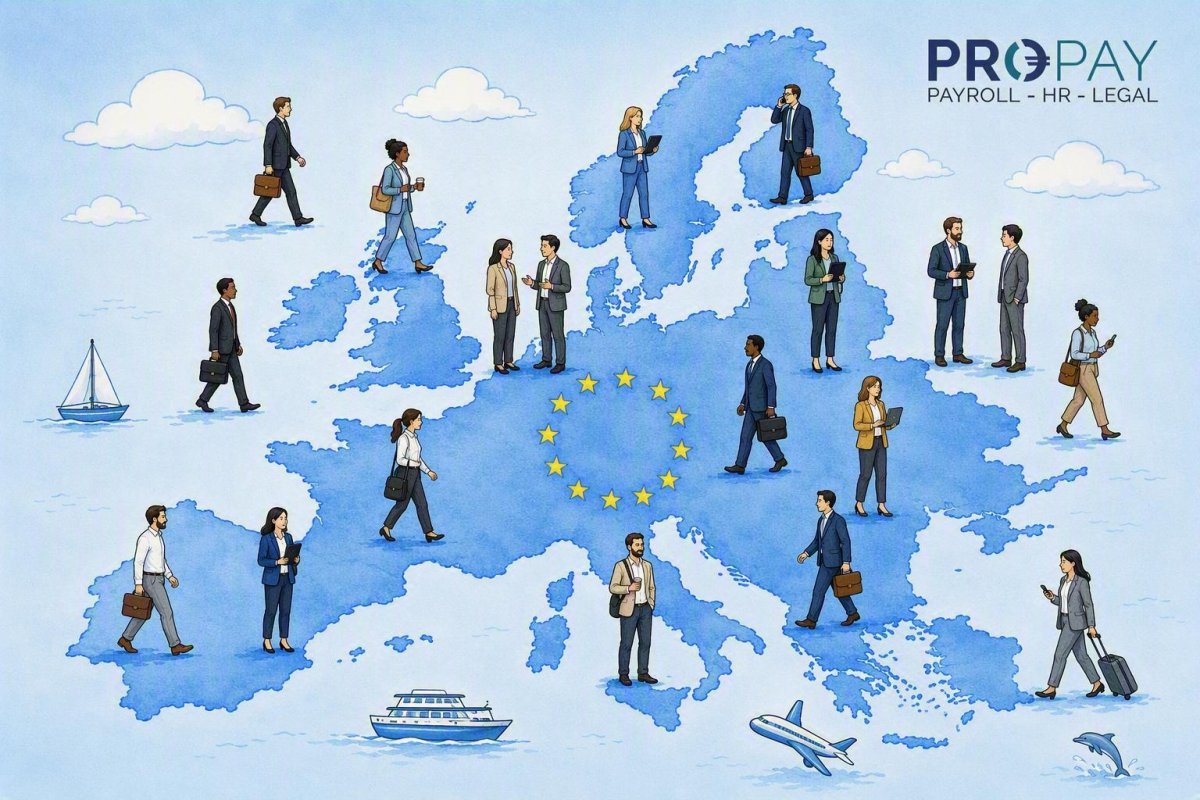
Given the increased telework following the Covid-19 pandemic, the EU Member States, Liechtenstein, Norway and Switzerland reached a framework agreement in June 2023. The purpose of this agreement is to prevent a shift in the applicable social security system when the employee’s country of residence from which telework is performed differs from the country where the employer is established. This Framework Agreement entered into force on 1 July 2023 (for more information, we refer to our newsletter of 12 October 2023).
1. Principles
The principles outlined in European Regulation 883/2004 regarding simultaneous employment in various Member States lead to a situation whereby substantial telework (minimum 25% of the working time) in the employee’s home Member State triggers social security coverage in the home Member State. As a result, an employer established in another Member State is to comply with the regulations of a social security regime with which it is not familiar.
To avoid this, the Framework Agreement provides that it is possible to apply the social security regime of the Member State where the employer is established, provided that notably:
- the employee teleworks minimum 25% and maximum 49,99% of his working time in his home Member State;
- the employee does not usually (more than 5% of his working time) work in another Member State than his home Member State or the Member State where the employer is established;
- employer and employee agree to opt for this special regime;
- both Member States involved are a party to the Framework Agreement.
2. Impact of professional activities in third countries on the 49,99% cap
Until recently, the Belgian social security authorities (“ONSS”) took the view that professional activities performed in third countries are to be disregarded when calculating the 49,99% cap under the Framework Agreement.
For example: the Framework Agreement could be applied in respect of an employee residing in Belgium and teleworking 40% in Belgium, 50% in the Netherlands for his Dutch employer and 10% in the United States of America (business trips). Because the US portion was disregarded by the ONSS, the employee only worked in Belgium and the Netherlands and the recalculated Belgian telework portion attained 44,4%. As a result, Dutch social security coverage under the Framework Agreement was an option.
The ONSS nevertheless had to amend its point of view following the Moguntia decision rendered by the European Court of Justice in December 2025. In this decision, the Court rules that professional activities that are habitually (more than 5%) performed in third countries and that are linked to the activities performed in the EU are also to be taken into consideration.
Applied to the above example: the Framework Agreement cannot be applied anymore because the employee habitually works in the United States of America , i.e. another country than the home Member State and the Member State where the employer is established. As a result, effective immediately the Belgian social security regime must be applied in such a situation.
3. Conclusion
The Moguntia decision limits the scope of application of the Framework Agreement, which can no longer be applied as from the moment that professional activities representing more than 5% of the total working time (including frequent business trips) are performed in third countries.
It is therefore strongly recommended to check the working pattern of your cross-border (tele-)workers to determine the impact of the Moguntia decision on the applicable social security regime.
Please do not hesitate to reach out via legal@pro-pay.be in case you wish to obtain further information.