






Summary of the 2026 newsletters

The year 2026 has been a particularly dynamic year in terms of legislative and regulatory developments in social security and employment law. The gradual implementation of the government agreement concluded in 2025 has resulted in the adoption of numerous measures, the most significant of which have been regularly highlighted in our newsletters throughout the year.
In addition to these reforms, the year has also been marked by the conclusion of several sectoral agreements for the 2025-2026 period, as well as the development of new reform projects currently under discussion in Parliament.
As the summer season tends to be a quieter time, we would like to provide you with an overview of the key developments that have taken place since the beginning of the year. This retrospective is intended to help you assess your compliance with the new obligations already in force, while also enabling you to anticipate upcoming changes, the details of which are still being finalized.
1. Federal level
| Subject | Content |
Previous newsletter(s) |
Action(s) to take |
|
Meal vouchers |
|
19 January 2026 |
✔︎ Verify at sector level whether there is an obligation to grant or increase meal vouchers. ✔︎ Sign an addendum if you introduce meal vouchers or increase their value and inform your payroll business partner accordingly. |
|
Return-to-Work Act |
|
✔︎ Update the working regulations (contact procedure, relapse period, absence without a medical certificate). ✔︎ Implement a structured follow-up process for long-term absences and request an assessment of the employee’s work potential as from 8 weeks of incapacity for work. |
|
|
FLA / ILA |
|
19 February 2026 |
✔︎ Continue maintaining an internal record of training completed by employees. ✔︎ For companies employing 20 or more employees: prepare the annual training plan. |
| Voluntary overtime |
|
|
✔︎ Draw up a written agreement before using the system (maximum term of 1 year, automatically renewable). |
| Act on various employment provisions |
|
✔︎ Adapt working regulations if you introduce a general framework for working schedule. ✔︎ Include an amendment for any change in the working hours of current part-time employees. |
|
|
Centimes index |
|
5 June 2026 |
N/A (automatically applied in payroll) |
|
Short Notice Period – First 6 Months |
|
30 June 2026 | / |
|
Flexi-jobs |
|
14 July 2026 |
If you wish to use flexi-jobs: ✔︎ Check whether your sector has an opt-out or restrictions in place. ✔︎ Verify the flexi-salary and other formalities (framework contract, flexi-contract, Dimona flexi) |
If you would like to learn more about the Return-to-Work Act, we invite you to join our webinar in September. Please feel free to register.
2. Sectoral Level
Here is a list of the joint industrial committees (sectors) applicable to Pro-Pay clients for which a sector-specific agreement has been adopted:
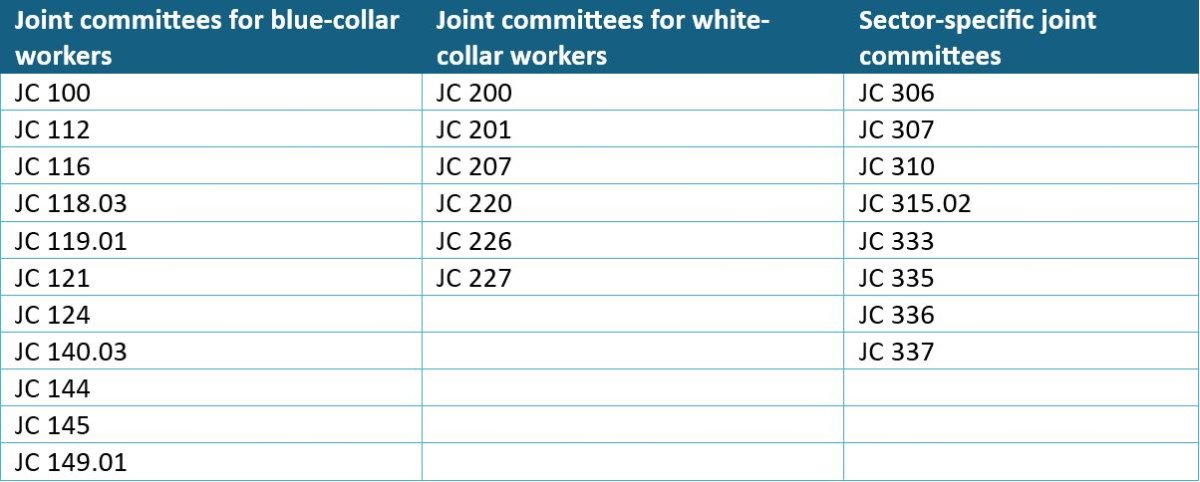
Upon the adoption of the sectoral agreements, either a newsletter was distributed or a communication was sent directly to you.
3. Measures announced pending final approval
Below is an overview of the main measures currently under development, whose entry into force remains subject to the adoption of final legislation:
-
Mandatory introduction of a mobility budget from 2027 for companies employing at least 50 employees, and from 2028 for companies employing at least 15 employees;
-
Implementation of the Individual Learning Account (ILA) as a tool for recording trainings completed by employees;
-
Annualization of working time, consisting of calculating the average working time over a reference period of one year;
-
Extension of the solidarity contribution payable by employers with at least 50 employes on average for employees aged 18 to 54 who have been incapacitated for work for more than 30 days (see table above). This contribution will be extended to cover the 4th and 5th months of incapacity;
-
Introduction of 5 additional days of leave per child and per family, in addition to the existing maternity leave and birth leave schemes. The entitlement would be granted as a priority to the father or co-parent.
This list may be amended as legislative work progresses and further measures are developed.