






Pay transparency is not just about reporting: what the directive actually focuses on and how to be prepared as an employer
Even though the deadline of 7 June 2026 for transposing the EU Pay Transparency Directive has passed, many questions and comments remain about its content.
Belgium has not met the deadline of 7 June 2026 to transpose the Directive. It has requested a six-month extension from the European Commission and has raised several questions regarding the practical application of the directive, including what should be considered as “pay.”
Although Belgium has not yet transposed the directive, there are many important preparatory steps companies can to take to ensure they are ready for its transposition.
Below, we provide an overview of the common misconceptions and outline the most important measures that a company will need to take to be prepared for the transposition of the directive.
Common misconceptions about the EU Pay Transparency Directive
❌ “Employees will be able to know exactly
how much their colleagues earn.”
✔︎ The directive was never intended to mean that employees
would know their colleagues’ exact salaries. It does grant
employees the right to request, in writing, information about their
own pay level and the average pay levels by gender for employees
performing the same or equal work.
❌ “The Pay Transparency Directive requires
employers to carry out benchmarking.”
✔︎ The directive does not require companies to have a market
benchmark in place to comply with its obligations. Rather than
imposing external benchmarking, the directive primarily requires
employers to ensure that their internal pay structures are objective,
gender-neutral, and based on clear criteria. A benchmark can be
a useful tool to support and validate these structures, but is
not necessary for compliance.
❌ “We have fewer than 100 employees, so we
don’t need to take any action at this stage.”
❌ “As the directive has not yet been transposed
into national law, we can simply wait until the
national legislation is published.”
✔︎ It is important for employers to fully understand the impact
of the directive and the extent of the preparatory work required,
regardless of company size or the timing of national transposition.
Even companies with fewer than 100 employees, which are not
subject to formal reporting obligations, remain impacted by all other
requirements that can have a significant operational effect. Pay
transparency requires organising pay in a fundamentally different way.
❌ “It will no longer be possible to grant different
salaries to employees within the same category.”
✔︎ Organizations that have not already start reviewing their job
classification systems and salary policies risk not being able to
respond to employees’ requests under their right to information
once the directive is implemented. If such requests reveal that equal
work is not being rewarded equally, this may lead to further review
or action. While the Directive requires equal pay for equal work or
work of equal value, it does allow differences in remuneration within the
same category, provided these are based on objective and
gender-neutral criteria.
The Directive provides for penalties for infringements of national provisions established in accordance with the Directive and relating to the right to equal pay. Such penalties will include fines. Furthermore, employees who have suffered damage/loss as a result of a breach of a right or obligation related to the principle of equal pay shall have the right to claim a retroactive compensation, as will be determined by the Member State. This entails full payment of outstanding remuneration, as well as related bonuses or benefits in kind, etc.)
Key measures to take ahead of the Directive’s transposition
Pay differences should be understood, their underlying causes recognised and employers should be able to explain why they exist. This starts with a clear job evaluation system and a consistent salary policy. The steps below set out how companies can put this into practice.
1. Review and update your job classification system
You should be able to demonstrate that jobs of equal value are remunerated equally. This requires clear job classifications, objective criteria and the identification of inconsistencies.
The EU Directive and the Commission clearly state that only a limited number of objective criteria will be accepted to determine the different salary categories. These criteria must be aligned with the four factors set out in the Directive: skills, effort, responsibility and working conditions. A formal job classification methodology should be introduced, if your organization does not have one yet. This does not necessarily imply the implementation of a complex system. The European Commission provides accessible guidance and practical tools for gender-neutral job evaluation.
➥ Pro-Pay can help you review your current job architecture and verify whether it meets the standards and expectations outlined in the Directive. We can assist you in finding a formal job classification methodology that suits your organisation. Given the importance of such a system in ensuring objectivity as required by the directive, this exercise can already begin, while implementation and alignment of HR practices may take time.
2. Analyse your remuneration data
Many organisations have the data but lack the insights. It is therefore important to analyse salary differences (for example, between men and women) and identify risks such as unexplained gaps.
Not only the gross salary but the total remuneration package must be taken into account. Often, the biggest differences will be found in the total remuneration component, as this includes extra benefits negotiated by employees. A complete compensation dataset with every pay element mapped per employee is necessary to be able to do a gender pay gap analysis.
➥ Pro-Pay can assist you using our tool to verify whether there is a pay gap and, if so, how significant it is, based on the available data.
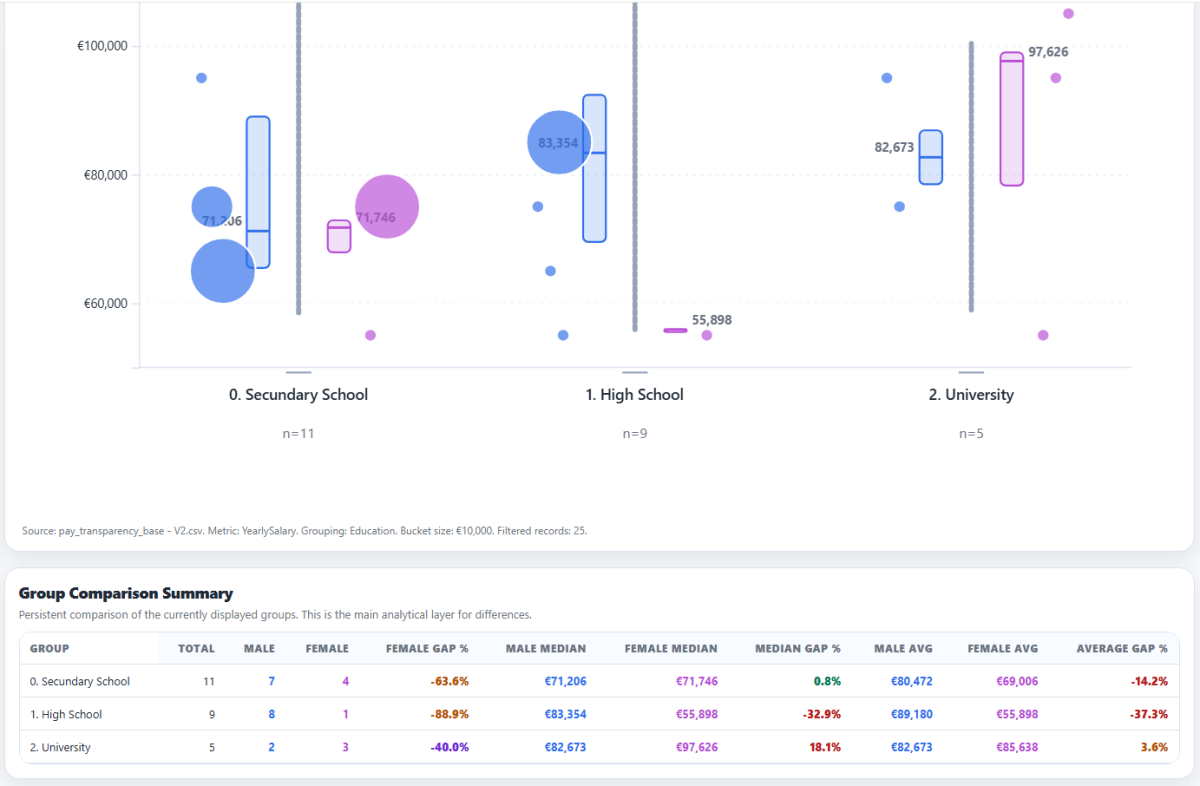
Preview of the tool
3. Document your salary policy
The burden of proof is shifting to the employer. Ensure it is clear how salaries are determined and that decisions regarding pay rises and promotions are properly documented.
➥ Pro-Pay can assist you with drafting and analysing your remuneration policy. We can assist with adapting existing salary policies to the requirements of the directive, such as setting midpoints, salary increases, mitigating outliers, etc.
4. Adapt your recruitment process
Salary ranges must be clear from the outset and recruiters must conduct interviews differently. Transparency begins before the start of employment.
➥ Pro-Pay can provide you with more detailed information on this step, based on the European Commission’s guidelines.
Do not hesitate to contact us for more information at legal@pro-pay.be. In addition, we invite you to register for our webinar series if you wish to stay informed about the latest legislative developments or deepen your knowledge of specific employment law topics. In December, we will be hosting a webinar entirely dedicated to pay transparency. More information is available on our website.