






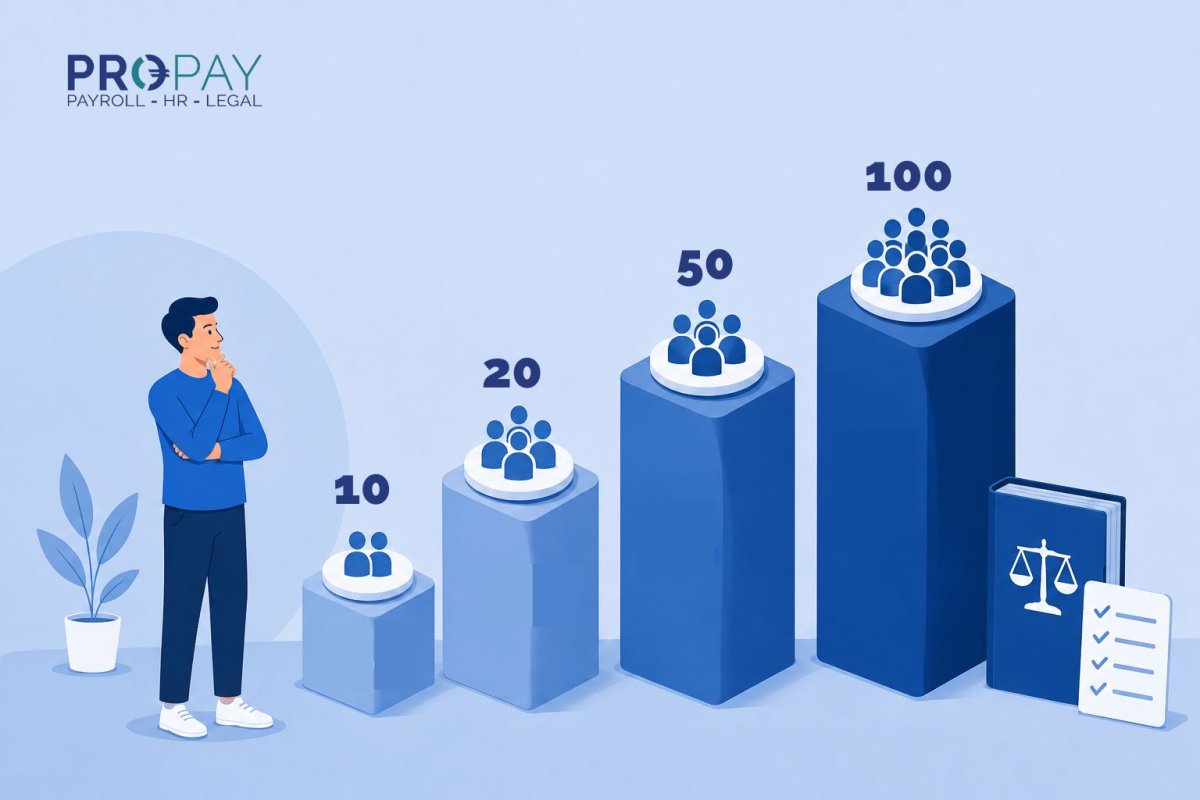
What legal obligations apply to companies with 10, 20, 50 and 100 employees?
The year 2026 marks the concrete implementation of the government agreement adopted the previous year. This development has resulted in the adoption of several new legal provisions, particularly in social security law and labour law, as reflected by our various newsletters published throughout the year. These developments lead to new obligations for both employees and employers.
Moreover, within the complex framework of Belgian social law, companies must also remain attentive to the legal obligations that apply to them depending on their size. Indeed, certain measures only become mandatory once a specific workforce threshold is reached.
This article aims to provide you with an overview of the main obligations under Belgian labour law related to the number of employees.
1. Summary of legal obligations according to company size
|
Company size |
Obligation | Description |
|
< 10 employees |
Individual training right |
Only where required by a sectoral CLA. |
|
10 to < 20 employees |
Individual training right |
Minimum 1 day/year/FTE; formal and informal training recognized. Exceptions possible via sectoral CLAs. |
| Mobility budget | Obligation to introduce a mobility budget from 15 employees (entry into force from 2028 – to be confirmed). | |
|
≥ 20 employees |
Right to disconnect |
Mandatory policy via CLA or working regulations (modalities, obligations, etc.) |
|
Employment plan for older employees (CLA 104) |
Annual plan to maintain/increase the employment of workers aged 45+. |
|
|
Individual training right (5 days) |
Average of 5 days/FTE over 5 years. |
|
|
Annual training plan |
Plan to be established before 31 March; mandatory consultation of employee representatives. |
|
|
Internal service for prevention and protection at work |
Obligation to organize an internal service; the prevention advisor must be an internal employee. |
|
|
Work potential evaluation |
Mandatory from 8 weeks of incapacity for work. |
|
|
Reintegration process |
Obligation to initiate a process within 6 months from the first day of incapacity for work. |
|
|
≥ 50 employees |
Social elections - CPPW |
Mandatory organisation every 4 years. |
|
Person of trust |
Mandatory designation of at least one internal person. |
|
|
Mobility budget |
Obligation to introduce a mobility budget (from 2027 – to be confirmed). |
|
|
Report on wage gap |
Biennial report using the simplified form. |
|
|
NSSO solidarity contribution in the event of long-term illness |
Obligation to pay a solidarity contribution for two months for workers aged from 18 to 54 years old who have been unable to work for more than 30 days. |
|
|
≥ 100 employees |
Social elections - WC |
Mandatory organisation every 4 years. |
|
Gender pay gap report |
Biennial report via full form. |
2. Details of the obligations
<10 employees
1. Individual training right
There is no general legal obligation to grant training days (individual right) except where this is provided for by a sectoral collective labour agreement (CLA).
From 10 to <20 employees
1. Individual training right
All employees in the companies concerned have an individual right to training. Only formal and informal training courses as defined by law are considered for this individual right.
Companies employing between 10 and fewer than 20 employees (in FTE) are required to guarantee at least 1 day of training per year and per FTE.
Please note that sectors (joint committees) may lay down specific rules in this respect (number of training days, formalities, etc.).
For more information on this obligation and the related procedures, we invite you to consult our newsletter of 19 February 2026.
2. Mobility budget (as of 2028)
Companies employing at least 15 employees will be required to introduce a mobility budget. All concerned employees will be able to opt for this budget, in accordance with the modalities defined in the internal policy. For more details about the mobility budget, please see our newsletters dated 25 January 2024, and 26 April 2022.
At this stage, no draft legislative text has yet been published, meaning that the full scope of this obligation is not yet known.
This obligation is expected to enter into force on 1 January 2028, subject to the publication of a legislative text in the Belgian Official Gazette.
As from 20 employees
1. Right to disconnect
The right to disconnect is the employee’s right not to be available through professional digital tools (such as mobile phones, email, and communication tools used by the company, etc.) outside working hours.
Companies employing at least 20 employees are required to implement such a policy through:
- either a company-level CLA,
- or the working regulations.
The policy must at least set out the modalities for applying the right to disconnect, the rules governing the use of digital tools, periods during which employees should not be contacted, etc.
We can provide you with a standard clause to be included in your working regulations.
2. Plan for the employment of older employees (CLA nr. 104)
Companies employing more than 20 employees (FTE) are required to draw up a plan for the employment of employees aged 45 and over. This plan must be established on an annual basis.
It is adopted following an information and consultation procedure that must start within 3 months of the end of the financial year, generally by 31 March.
The plan includes measures aimed at maintaining or increasing the number of employees aged 45 and over. To this end, the employer may choose from a (non-exhaustive) list of areas of action provided for in the CLA, including:
- the selection and recruitment of new employees;
- the development of the employees’ skills and qualifications, including access to training;
- career development and professional guidance within the company;
- etc.
We can provide you with a plan template and assist you in completing it.
3. Individual training right and annual training plan
Companies employing at least 20 employees in FTE are subject to a double obligation:
-
to comply with an individual right to training of 5 days per year per full-time employee (average over a period of 5 years);
-
Prepare an annual training plan and communicate it to and/or consult on it with the employee representatives (Works Council, Committee for Prevention and Protection at Work, or Trade Union Delegation) no later than 31 March, unless a sector-specific derogatory regime applies. Within one month of its entry into force, the plan must be registered electronically with the competent authorities.
Please note that sectors (joint committees) may lay down specific rules in this respect (number of training days, formalities, etc.).
We can provide you with a template plan and assist you in completing it and submitting it to the relevant Belgian authorities.
For more information on the training plan and the procedure for drafting and filing it, we invite you to read our newsletters of 12 March 2024 and 17 February 2025.
4. Organisation of the internal service for prevention and protection at work
All companies must establish an internal service for prevention and protection at work (ISPPW) with at least one prevention advisor. In companies with at least 20 employees, the internal prevention advisor must be an employee of the company and can no longer be the employer.
It is recommended to draw up an addendum to the employment contract of the appointed prevention advisor in order to formalize this role and the responsibilities associated with it.
In addition, the appointment of the prevention advisor must follow a specific procedure. Finally, the prevention advisor must have appropriate and specific training corresponding to their level of function.
5. “Work potential” evaluation and reintegration process
In January 2026, the Code on Well-being at Work was amended to introduce an obligation for employers to request an assessment of the employee’s “work potential” in the event of incapacity for work as from 8 weeks of absence.
Where the assessment concludes that there is work potential, employers employing at least 20 employees are required to initiate a reintegration process within 6 months following the start of the incapacity for work.
These obligations apply to all cases of incapacity for work starting from 1 January 2026.
As from 50 employees
1. Social elections – Committee for Prevention and Protection at Work (CPBW)
Companies employing at least 50 employees during a specific reference period provided for by law are required to organize social elections every four years to elect employee representatives to the Committee for Prevention and Protection at Work (hereinafter “CPBW”).
The CPBW is a consultative body composed of representatives of the employer and the employees and has as its main task to ensure well-being at work by providing advice and participating in the implementation of safety measures. Once the CPBW has been established, the company is required to consult it on numerous matters relating to well-being, prevention, internal policies, etc.
The next social elections will take place in 2028.
2. Trusted person – general obligation
The appointment of at least one trusted person is mandatory in companies employing 50 employees or more. At least one trusted person must be an internal staff member.
The trusted person must have completed specific training of at least five days within two years following their appointment.
3. Gender pay gap report (analysis of the remuneration structure)
Companies that usually employ an average of at least 50 employees are required to draw up a remuneration structure analysis report every two years. The purpose of this report is to identify, and remedy pay gaps between men and women.
- Companies employing between 50 and 99 employees must comply with the abbreviated form;
- Companies employing ≥ 100 employees must comply with the full form.
The above-mentioned forms (in Dutch or French) are made available by the competent authorities and can be accessed via the following :
Furthermore, if you are a Pro-Pay payroll client, we are able to provide you with a completed report based on the data recorded in our payroll system.
4. NSSO solidarity contribution in the event of long-term illness
A solidarity contribution is due by employers employing an average of at least 50 employees for workers aged 18 to 54 who have been in incapacity for work for more than 30 days. Temporary agency workers, flexi-job workers, and occasional workers in certain specific sectors are excluded from this measure.
The contribution amounts to 30% of the incapacity-for-work benefit received by the employee for a period of two months starting from the 31st day of incapacity for work. This contribution is collected automatically by the National Social Security Office (NSSO).
On 18 July 2026, the Council of Ministers approved a preliminary draft legal text extending the obligation to pay the solidarity contribution for an additional two months. As a result, the contribution would also apply during the 4th and 5th month of incapacity for work. The additional revenue generated by this contribution would be returned in full to the companies concerned, regardless of whether they actually paid the contribution.
This measure remains subject to the publication of the relevant legislative text in the Belgian Official Gazette.
5. Mobility budget (as of 2027)
Companies employing at least 50 employees will be required to introduce a mobility budget. All concerned employees will be able to opt for this budget, in accordance with the modalities defined in the internal policy.
At this stage, no draft legislative text has yet been published, meaning that the full scope of this obligation is not yet known.
This obligation is expected to enter into force on 1 January 2027, subject to the publication of a legislative text in the Belgian Official Gazette.
As from 100 employees
1. Social elections – Works council
Companies that usually employ an average of at least 100 employees during a specific reference period provided for by law are required to organize social elections every four years to elect employee representatives to the Works council. If a Works council already exists, renewal through social elections becomes mandatory as from 50 employees.
The underlying obligation linked to the establishment of a Works council is to inform and consult it on several matters (economic situation, employment structure, work organization, etc.).
Action point: It is therefore essential for companies to be aware that their size may – or may not – trigger the application of certain obligations under social law, in order to ensure compliant and efficient management.
If you have any questions regarding any of these obligations or would like an overview of the requirements applicable to your company, please do not hesitate to contact us at legal@pro-pay.be.